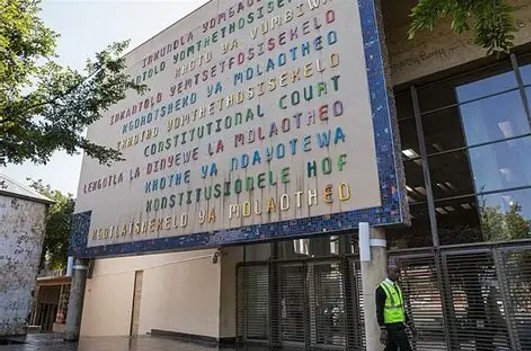
Source: https://commons.wikimedia.org/wiki/File:Constitutional_Court_South_Africa.jpg

On 26 June 2026, the Constitutional Court of South Africa delivered its landmark judgment in the Ex Parte application of President Ramaphosa in re: Constitutionality of the Copyright Amendment Bill (CAB) and the Performers’ Protection Amendment Bill (Case CCT 306/24).
Fair use was a central point of contention throughout the copyright reform process. In its judgment, the Court affirmed the constitutionality of the fair use provision and most of the related exceptions under review. Only Section 12D (1–5), which governs educational reproduction, was declared unconstitutionaldue to its incompatibility with constitutional requirements. However, Section 12D (6–9) was upheld as constitutional, and therefore remains a valid and enforceable component of the Bill.
The Court Order reads as follows:
On referral from the President of the Republic of South Africa in terms of sections 79(4)(b) and 84(2)(c) of the Constitution:
- The referral by the President in terms of section 79 of the Constitution in respect of sections 6A, 7A and 8A of the Copyright Amendment Bill, 2017 (CAB) as a whole is incompetent.
- The fair use exception in section 12A of the CAB is not arbitrary and does not infringe the right to property under section 25(1) of the Constitution and is constitutional within the scope of the President’s referral.
- The exceptions in sections 12B and 12C of the CAB are not arbitrary, do not infringe the right to property under section 25(1) of the Constitution and are constitutional within the scope of the President’s referral.
- The exceptions in subsections 12D (1)-(5) of the CAB constitute an arbitrary deprivation of property under section 25(1) of the Constitution and are unconstitutional.
- The exceptions in subsections 12D (6)-(9) of the CAB are not arbitrary, do not infringe the right to property under section 25(1) of the Constitution and are constitutional within the scope of the President’s referral.
- Section 19B of the CAB is not arbitrary, does not infringe the right to property under section 25(1) of the Constitution and is constitutional within the scope of the President’s referral.
- Section 19C of the CAB is not vague and does not constitute an arbitrary deprivation of property under section 25(1) of the Constitution.
- The orders in paragraphs 1-7 in relation to the CAB also apply to the relevant sections of the Performers’ Protection Amendment Bill, 2017.
Despite the Constitutional Court’s judgment, opponents of the CAB continue to make public statements claiming that fair use is unconstitutional, or that the entire Copyright Amendment Bill is unconstitutional. These claims are incorrect and misleading. The Constitutional Court did not find fair use unconstitutional, nor did it declare the CAB unconstitutional in its entirety. Continuing to make such claims risks creating unnecessary public confusion, particularly among those who may not be familiar with the details of the judgment or its legal implications.
At the recent IP for Growth workshop in Johannesburg, convened by the U.S. Consulate General Johannesburg, U.S. Mission Geneva, and Universal Music Group, some participants and even a presenter claimed, without correction, that the CAB had undergone neither economic assessment nor meaningful consultation with the creative industries. These claims are misleading. An economic assessment was conducted by the Department of Trade and Industry, while extensive countrywide consultation has been ongoing since the CAB was first published in 2015, including a multistakeholder conference and regional workshops, written submissions across multiple rounds of public participation, including further submissions and comments on specific clauses and amendments, as well as public hearings held by Parliament and the Provincial Legislatures. Disagreement with the outcomes of these processes should not be presented as evidence that they did not take place.
As EIFL states: “Since the Copyright Amendment Bill was introduced in parliament in 2017, over 90 official activities and events have taken place, including public consultations, stakeholder meetings, technical expert reviews, legal briefings and debates, making it one of the most scrutinized copyright bills in the world. The Bill has twice been passed by both Houses of Parliament and sent to the President for assent. The President has twice questioned the constitutionality of some of the provisions (including copyright exceptions for educational and academic activities).”
On 15 October 2024, the President referred the Bill to the Constitutional Court for a ruling on its constitutionality in terms of Sections 79(4)(b) and 84(2)(c) of the Constitution. Yet again, during the Constitutional Court hearings on 21 and 22 May 2026, stakeholders, as amici curiae, had a further opportunity to present their positions on the Bill to the judges. The creative/entertainment industries and others were well represented at all stages of the Bill and in the Constitutional Court hearings.
The Court gave no specific instructions regarding the next steps for the Copyright Amendment Bill and Performers’ Protection Bill. In her article, Professor Chijioke Okorie from the University of Pretoria, states: “the ball is in Parliament’s court to decide whether to strip out the bits held unconstitutional, finalise the Bill, and send it to the President for signature. That to me is the path of least resistance: given the Constitutional Court’s ruling on those provisions, the President cannot raise constitutional reservations about them again.”
In view of the Court’s judgment, policymakers and affected institutions will now need to consider revising or replacing the provisions that have been invalidated. It is hoped that a decision on the way forward will be reached as soon as possible, allowing the Bill to be revised and resubmitted to Parliament for approval and, ultimately, presented to the President for assent.
Recent Comments