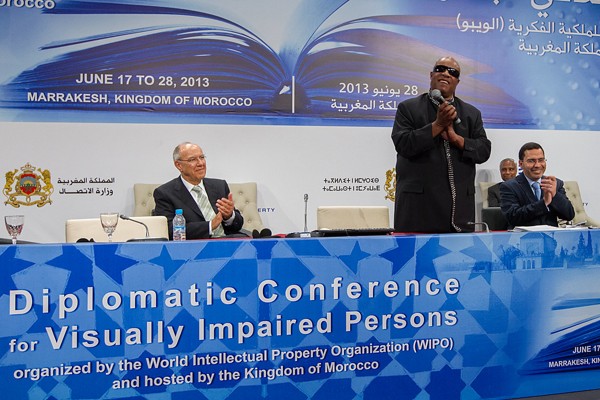
What is the Marrakesh Treaty?
To date all Treaties adopted by the World Intellectual Property Organization (“WIPO”) have protected the rights of copyright owners. On 27 June 2013, in Marrakesh, North Africa, the first WIPO Treaty to protect users’ rights was adopted and is entitled “The Marrakesh Treaty to Facilitate Access to Published Works for Persons Who Are Blind, Visually Impaired or Otherwise Disabled (“the Treaty”)[1].
The Treaty establishes international minimum standards specifically to benefit users of copyright-protected materials. It has the potential to substantially expand the global availability of works in accessible formats, while enabling their cross-border exchange for the benefit of people with print disabilities in both developed and developing countries.
The Treaty entered into force on September 30, 2016, after WIPO received 20 instruments of ratification or accession from member states. Currently, 131 WIPO member states have acceded to or ratified this Treaty. 27 African states have ratified or acceded to the Treaty, although it is currently in force in 26 of them. The Treaty enters into force for Niger only on 20 October 2026.[2]
Must amendment of national laws precede accession to the Treaty?
There is no mandate, obligation, or deadline that requires national laws to be amended before accession or ratification of the Treaty.
According to WIPO’s summary, the Treaty
requires Contracting Parties to introduce a standard set of limitations and exceptions to copyright rules to permit reproduction, distribution, and making available of published works in formats designed to be accessible to [visually impaired persons], and to permit exchange of these works across borders by organizations that serve those beneficiaries.
Most African members of the Treaty have acceded to it, but have not yet implemented the provisions of the Treaty in their national laws. Some have pre-Marrakesh exceptions, whilst others have adopted selected Marrakesh-related exceptions but have not fully implemented the Treaty’s requirements.
Why has South Africa not acceded to the Treaty?
Despite strong support for the Treaty when it was adopted in 2013, South Africa has not yet acceded to the Treaty. Its intention is to accede to it once the Copyright Amendment Bill is passed into law.
In a presentation by the Department of Trade and Industry to the Portfolio Committee on Trade and Industry in February 2019, it stated that:
- Legal opinions on the Marrakesh Treaty were received from DOJ & CD and DIRCO on 17 May 2008 and 26 June 2018 respectively.
- The DOJ & CD is of the view that the Marrakesh Treaty should only be acceded to once the Copyright Amendment Bill gets passed into law and provided that it is passed with the provisions giving effect to the provisions of the Marrakesh Treaty.
- DOJ & CD is concerned that if there is resistance to the Copyright Amendment Bill with regard to provisions relating to Marrakesh Treaty, South Africa would be bound by its international commitments to the disadvantage of domestic obligations.
- DIRCO has also conformed with DOJ and CD’s legal opinion and requested to be furnished with confirmation that South African Law is compliance with the Treaty prior to facilitating accession. [3]
So, when is the Copyright Amendment Bill likely to be passed into law?
Since its genesis in 2009, the Copyright Amendment Bill has been 17 years in the making. It has followed a long and contested path with many hurdles and delays and has still not been passed into law. The Draft Amendment Bill was first published for public comment in mid-2015 and was presented to Parliament in 2017 to proceed with the legislative process through the Portfolio Committee on Trade and Industry and then the National Council of Provinces.
The Bill was first approved by both Houses of Parliament on 28 March 2019, but President Ramaphosa declined to sign it. On 16 June 2020, he referred the Bill back to Parliament for a review of some clauses, suggesting that they may not be constitutional. At the same time the Bill was retagged from a Section 75 Bill (national) to a Section 76 Bill (provincial), requiring a further process through the nine Provincial Legislatures. The Bill was again passed by Parliament on 29 February 2024.
Instead of signing the Bill, the President referred the Bill to the Constitutional Court in October 2024, raising concern that the reviewed clauses may still not be constitutional. The Constitutional Court heard the matter on 21 and 22 March 2025 and handed down judgment on the 26 June 2026. Its Order reads as follows: –
On referral from the President of the Republic of South Africa in terms of sections 79(4)(b) and 84(2)(c) of the Constitution:
1. The referral by the President in terms of section 79 of the Constitution in respect of sections 6A, 7A and 8A of the Copyright Amendment Bill, 2017 (CAB) as a whole is incompetent.
2. The fair use exception in section 12A of the CAB is not arbitrary and does not infringe the right to property under section 25(1) of the Constitution and is constitutional within the scope of the President’s referral.
3. The exceptions in sections 12B and 12C of the CAB are not arbitrary, do not infringe the right to property under section 25(1) of the Constitution and are constitutional within the scope of the President’s referral.
4. The exceptions in subsections 12D (1)-(5) of the CAB constitute an arbitrary deprivation of property under section 25(1) of the Constitution and are unconstitutional.
5. The exceptions in subsections 12D (6)-(9) of the CAB are not arbitrary, do not infringe the right to property under section 25(1) of the Constitution and are constitutional within the scope of the President’s referral.
6. Section 19B of the CAB is not arbitrary, does not infringe the right to property under section 25(1) of the Constitution and is constitutional within the scope of the President’s referral.
7. Section 19C of the CAB is not vague and does not constitute an arbitrary deprivation of property under section 25(1) of the Constitution.
8. The orders in paragraphs 1-7 in relation to the CAB also apply to the relevant sections of the Performers’ Protection Amendment Bill, 2017.
This means that the Bill cannot proceed to the President for assent, until such time as relevant sections have been amended and the Bill has once again been approved by Parliament. Three and a half months have passed since the judgment, but there has been no indication from the Presidency or the Department of Trade, Industry and Competition, as to what action will be taken to remedy this situation so that the Bill can finally be assented to by the President.
How have the Bill’s ongoing delays affected blind and visually impaired people in South Africa?
The ongoing delays have perpetuated the ‘book famine’ and failed to give blind and visually impaired people the dignity and rights they deserve in terms of our Constitution and international human rights conventions, and denied them the benefits of the Marrakesh Treaty.
Impatient with long delays and failure of the President to sign the Copyright Amendment Bill Blind SA, assisted by NGO, Section 27, has been forced to institute legal action against the Minister of Trade, Industry and Competition and others on a number of occasions to recognise the rights of blind and visually impaired people in South Africa. The President was a respondent in all three proceedings as below, but only the third case was titled directly as Blind SA v President.
- Blind SA v Minister of Trade, Industry and Competition and Others — Gauteng High Court, Pretoria, case 14996/21, decided 7 December 2021.
Blind SA challenged sections 6 and 7, read with section 23, of the Copyright Act because they prevented people with visual and print disabilities from converting copyrighted works into accessible formats without the copyright owner’s permission. The High Court declared the Act unconstitutional to that extent. The President was cited as the fifth respondent.[4]
- Blind SA v Minister of Trade, Industry and Competition and Others — Constitutional Court, CCT 320/21; [2022] ZACC 33, decided 21 September 2022.
The Constitutional Court confirmed the High Court’s ruling of 7 December 2021 that the Copyright Act infringed the rights to equality, dignity, freedom of expression, education and participation in cultural life. It temporarily read section 13A into the Act and gave Parliament 24 months to correct the law.[5]
- Blind SA v President of the Republic of South Africa and Others — Constitutional Court, CCT 300/24; [2025] ZACC 9, decided 7 May 2025, following an interim order on 13 December 2024.
In October 2024, Blind SA brought an urgent direct-access application after the 24-month period expired without corrective legislation taking effect. The Court inserted an interim section 19D into the Copyright Act, permitting accessible-format copies, including their cross-border exchange, without the copyright owner’s authorisation, pending permanent legislation. [6]
What is the next step?
In the words of Christo de Klerk, President of Blind SA:
The time for excuses is over. The government’s continued inaction is indefensible. We demand that the government immediately and without further delay begin the process of acceding to the Marrakesh Treaty.
We further call for a clear and transparent timeline and for consistent engagement with the disability sector throughout this process. Our constitutional rights to dignity, equality, and access to information are not negotiable.
The government must act now, not only to fulfil its legal obligations, but to uphold the values of justice and inclusion. The world is watching. [7]
Since the Constitutional Court’s ruling of 7 May 2025 has brought the Act into compliance with the Marrakesh Treaty, there is no apparent legal impediment to South Africa acceding to the Treaty. South Africa must act now!
- [1]https://www.wipo.int/en/web/treaties/ip/marrakesh/index
- [2] https://www.wipo.int/wipolex/en/treaties/ShowResults?search_what=C&treaty_id=843
- [3] https://www.thedtic.gov.za/wp-content/uploads/WIPO_Treaties.pdf
- [4] https://www.saflii.org/za/cases/ZAGPPHC/2021/871.html
- [5] https://www.saflii.org/za/cases/ZACC/2022/33.html
- [6] https://www.concourt.org.za/index.php/judgement/591-blind-sa-v-president-of-the-republic-of-south-africa-and-others-cct300-24
- [7] https://groundup.org.za/article/all-they-ask-is-access-to-books-sa-is-failing-the-blind/
Recent Comments